Saturday, 18 July 2015

Black sapote icecream and mango wine

We found Sapotes! There were only seven pieces all up in the Mareeba markets, but we were chuffed as we have been on the lookout for them since we saw them in a travel show on the area. The stall holder had two different kinds of Sapotes on their unpretentious little table and we bought both and had to wait four days for them to ripen. These are the Black Sapotes. When you open them they are a bit like persimmon, and mixed with icecream they taste a little like chocolate with a tang of chilli, though after all that searching it is not something we will want for dessert very often, we have since decided. 

The marketeers also had white eggplants, which we had to try. These are more subtle than the purple, but still with that lovely eggplant flavour we enjoy so well and can be cooked in so many different ways. In other stalls we found pomolo, pitaya, custard apples the size of soccer balls, and Asian greens so crispy, crunchy and clean it makes you realise how old even the freshest supermarket vegetables that we buy really are. This produce comes straight from the field to the market. Our motorhome was groaning with produce by the time we’d finished shopping and it was easily one of the freshest food markets we have visited anywhere.

We chatted to a young Chinese market gardener and his grandpa who had been growing different oyster mushrooms from scratch. Actually, grandpa had contract growers working for him all over North Queensland so he had likely cornered the mushroom market in the region with orders coming thick, fast and firm. The pair had completely sold out of every type of mushroom when we came upon their stall and were packing, early, to go home, though interrupted all the while by customers who were obviously disappointed that they were too late to buy.

They told us how they grew their mushrooms: they started with a sawdust mix in a plastic bag, then put in the spores and simply allowed the mix to work its magic. This is the remnant of a block of oyster mushrooms that had been the display on their market table. Even their display block had been heavily harvested by keen customers not wanting to miss out on their weekly order. 

Mareeba has the best Heritage Museum in any country town in Australia that we have ever visited. And it is run by volunteers in the main. Amazing the work volunteers do in these country towns around here. They have set up ‘rooms’ of displays on the early beginnings of the area, the gold industry in the region, the timber industry, and the wetlands: with endless looping videos one of them has put together of bird calls, birds nesting types, and bird behaviours, beautifully filmed and edited. They have built life size models of early shops using corrugated iron and timber to illustrate the early days: saddlers, butchers, ironmongers, done up with signage of the times. And have collections of machinery and memorabilia all brilliantly labelled and immaculately maintained. A wonderful museum. We went back three times in the time were in the district and still have not seen it all. 

We drove out to Mareeba’s wetlands, a man-made wet area of lakes and creeks that has become a bit of a bird watcher’s paradise. Here we found an aviary of very rare Gouldian Finches being bred for release back into the wild. Seventy were released into sensitive habitat areas just last year, so the breeding program is working well.

We also saw several Jabiru, a lovely stork-like bird which is only found in these northern regions. A graceful and very pretty bird. 

Then we called in to Australia’s first, and possibly only, mango winery in Mareeba and, though I am a merlot fan, we loved every wine they produced: the dry, the medium, the sweet, the sparkling. We came away with their mango liqueur which we could not resist, along with a delicious limoncello. 

And given that the Nastasi family’s roots are steeped in Italian ancestry we have no doubt this is a home grown and authentic recipe. Just using cellar door sales the Golden Pride winery is regularly chomping through every mango it can grow, as well as employing over 150 pickers in season. We were fascinated by their heavily pruned mango trees. Once a year they have a close shave which cuts them low on top, with their sides trimmed like a four sided cube, making it easier to pick the lower fruit. A very expensive process one of the family said, but well worth it. 

The weekend we were in Mareeba was, by chance, their Rodeo weekend. The only other Rodeo we have ever visited was the Calgary Stampede, so long ago we could barely remember what it was all about, so off we trotted to spend a sunlight afternoon on the bleachers, watching the bruises and broken bits that result from calf roping and bulldogging, bullock riding and buck jumping. 

My nephew does this for fun. Such regular body punishment occurs during these events that I fear for him in his old age. Surely these riders will all be arthritic or crippled by then. 

And if that doesn’t get them early then the rodeo fare surely must: deep fried pluto pups the size of tree limbs. Giant potatoes cut in long swirls hreaded onto sticks, dipped in batter and salt and doused in hot cooking fat until they are crisp. Pyramids of empty pop cans along with endless Eskies of heavy beer. Hot pies oozing with artery clogging meat and fat chunks. Topped off with the Rodeo Show Bags overflowing with giant chocolate bars for dessert. 

Not a fresh apple within cooee. Let alone a bottle of water. And the little ones begin training for this at eight while riding the farm’s poddy calves. I fear for them, too.


Scarce black sapotes 


Such fresh greens


Oyster mushrooms galore


Mareeba's Heritage Museum


Gouldian finches in aviary in Mareeba's wetlands


Dozens are released into the wild every year


Jabiru


Rodeo


Bronco jumping at Mareeba


Relaxing between events


Tuesday, 14 July 2015

Haunting treasures and tales

Cooktown kept us busy. We arrived in the heat of ‘the dry’ day and searched out the coolest thing we could find to do, which ended up being a visit to the Botanic Gardens, where it is all shade and green at this time of the year. We spent half the afternoon there as it was so interesting, and had much of the place to ourselves. 

We found a garden devoted wholly to the plants that Joseph Banks and his naturalist colleagues onboard the Endeavour first recorded when they were here repairing the hull of their famous ship. Someone’s lovely idea for an innovative garden which we thoroughly appreciated. 

Prior to this, in the gallery at the Botanic Gardens, we visited an exhibition by Vera Scarth-Johnson, who had been a talented local artist, who had painted all the plants systematically recorded by Banks and his botanists in 1770. When she died she left her entire collection to the Cooktown community and in her honour they built a gallery so that her exquisite botanical works might be displayed for others to enjoy. Another lovely contribution by the Cooktown community that really complimented the garden pieces. 

We visited a garden devoted to the Chinese: showing what they planted, and how they likely kept the gold miners of the north healthy, providing greens that would have kept them free from diseases such as scurvy. We heard, too, of negative things. The Botanic Gardens in Cooktown came into being pretty much solely as an attempt to limit the land spread by the Chinese who were using trees in this area for their charcoal burners, and to expand their market gardens. To put a stop to this, the authorities claimed they needed the land for a botanic gardens, so the Chinese activities were eventually stalled. 

We are endlessly fascinated by the stories of the Chinese here in the north and want to learn more about them, so have that earmarked as a future project for when we have time and access to the right resources. 

Further along in the gardens we found our first vanilla orchid plant climbing its fragile way to the sun. Commercial vanilla beans so prized in our cooking grow on plants such as these. We looked for, but could not find, sapotes, so we are still on the hunt for these. 

We then visited the old Mercy Convent which has been set up, now, as the James Cook Historical Museum, run by the National Trust with the invaluable assistance of some excellent volunteers, who offer informative talks on early Cooktown, on the story of the Convent itself and the five Irish nuns who ran it, along with tales of Cook and his crew. We listened to all on offer. These volunteers know their subject matter: they knew which day of the week the Endeavour rammed into the reef, and precisely to the minute how long the sailors needed to stay in the north in order to repair it. Far longer than we remembered from school days. Over 40 days, Cook and his men were here, and in that time they managed to befriend the locals, then to deeply offend them, when they refused to share their catch of turtles; then, just before they left, to reconcile with them, in one of the sacred no-war-zone spaces, near their encampment. 

This, the devoted Cooktown volunteers argued, was really the first reconciliation with traditional owners in Australia. As well, they argued, Cook’s stay should be considered Australia’s ‘first’ settlement. So, history might need to reconsider the dates on these happenings if our Cooktown volunteers ever lobby long, loudly and well enough. 

The museum displays a good-sized anchor left behind by the Endeavour, built from a massive piece of wood trimmed with heavy metal. Also on display is a cannon rescued from its watery grave after being thrown overboard to lighten the ship when she was nearly in her death throes. Museum information panels tell the story of those who uncovered these pieces from deep in the reef, and how they were brought to the surface. Also on display is the trunk of the very tree that the Endeavour was anchored to when it was finally safely moored for repairs after the successful fothering attempt which temporarily stemmed the leakage caused by the coral cuts to its boat hull. Amazing bits of real history here. 

Down on the waterfront we found a statue in memory of Captain James Cook sited where he might have stood on Cooktown soil. And all along the waterfront where the Endeavour was beached locals have raised memorials and murals so it is quite a promenade. As well as being picturesque. Cook and his men must have found it quite hard to leave, though one of his diary entries does record swatting hostile mosquitos that were constantly bedevilling them. Luckily, these pesky little critters were not about when we were there — at approximately the same time of year. For that we were thankful. 

The next day we visited the historic cemetery which encapsulates Cooktown’s unique multi-cultural history in just a few hectares. One section of the cemetery is devoted to the many Chinese buried here, and a memorial has been raised to them. 

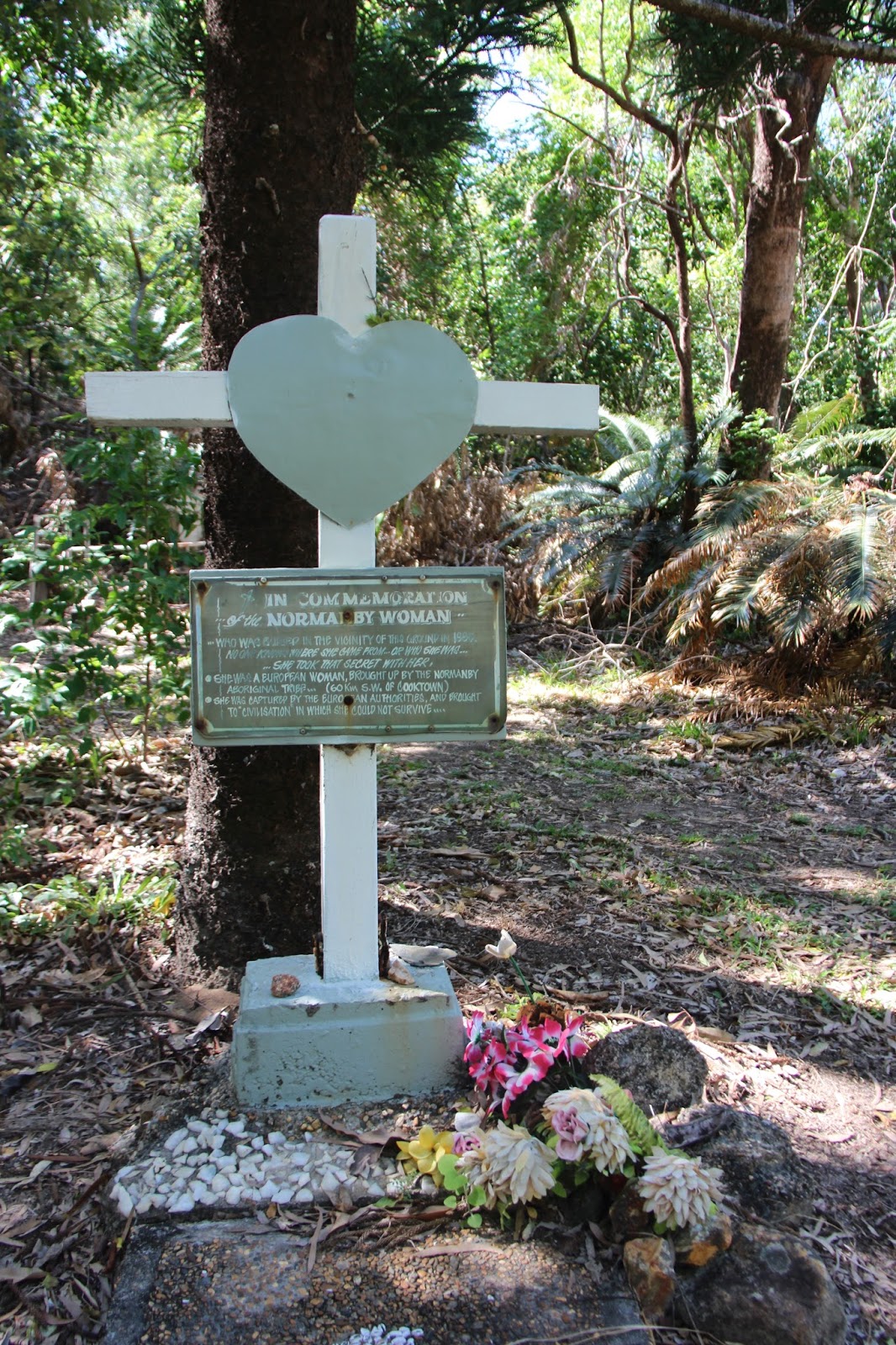
We also found a single humble monument in memory of a woman whose name is not known. She is called the Normanby Woman. During the early days of the Palmer River gold rush, around 1886, this white skinned woman was found living with a tribe of local Aborigines. When authorities intervened and removed her from the camp there was a struggle, spears were thrown and the young woman fell from her horse, but still she was captured, and carried away from what had been her home. Though, not to live long. She apparently refused food, and died not long after in Cooktown, reportedly unable to live in the white man’s world. Who she was, and how she came to even be in these parts, is still a complete mystery. 

On another headstone in the cemetery, an epic and tragic tale is told of a young mother, Mary Watson, and her baby son, Ferrier. About ten years after migrating from England with her parents, Mary married a beche de mer fisherman and together they moved to Lizard Island, where their little boy, Ferrier, was born in 1881. Later that year, when her husband was away working, the Watson home was attacked by local Aborigines angry at discovering that one of their sacred sites was being occupied by Europeans. Despite putting up a good fight, once Mary lost one of her Chinese servants in the struggle, she decided to flee by sea. With her child and her remaining servant Ah Sam, she pushed out to sea in all that she had to use as a boat: a boiling down tank. They attempted to make land in such an unseaworthy craft. Such steely determination — and fear — they must have been feeling. When Howick Island eventually came into view Mary must have allowed herself a sigh of relief. Her hopes for safe keeping must have been high. But, here, sadly, they were unable to find fresh water. Their last days were recorded in detail in a tragic diary Mary managed to maintain. Desperation for a single drop of water for herself and her little family was evident in every entry. Her journal and their three bodies were found by searchers, but far too late. 

The treasures and tales of Cooktown’s history we found really haunting.

Vanilla orchid plant


Captain James Cook


Picturesque Endeavour River


Memorial to the Cooktown Chinese


Memorial to the Normanby Woman


Mary and Ferrier Watson


Sunday, 12 July 2015

Lure of gold

We camped overnight at the Palmer River roadhouse. This was gold country in the late 1800s, founded by James Venture Mulligan after whom this highway is now named. One of the early prospectors and explorers, he discovered gold out here, and started another massive rush. Men came from all directions, most just wheeling barrows filled with their worldly possessions as well as their gold digging equipment. Without even a horse to their name. 

You can sense history out here. Once these hills rang to the clang of metal tools banging on rock, and water gushing down sluices separating out gold bits from the rubble. The number of Chinese miners, moneylenders and merchants who ventured onto these fields astonished us. We had no idea. Some 18,000 at the peak of the gold rush in the 1890s, we were told. More of a presence in these fields than the Europeans at the time. 

Some came overland from other sites in Australia, but not many. Most were indentured labourers sent from Gangzhou. In peak periods boats were dropping Chinese workers destined for the goldfields, in numbers that sometimes reached a thousand a week. Young single men they were, mainly, in their twenties and thirties. 

They were expected to send home gold in return for product and assistance. Some of their tales are traumatic. So difficult did it become for them to ship back the necessary payment that some were forced to hide in the hollowed out body parts of their dead friends and relatives: in the belly cavity, in the stripped out bone marrow.

There are many traumatic tales of these times on the goldfields. One old fellow was found in a camp shelter he had made from a dried out termite mound. He had hollowed it out as his home. He had few utensils, very little food, no swag, so no home comforts at all. He did not, or would not, talk and had no paper identification. When taken to the nearest police station he was found to be a white man of about 50 years or more, with blue eyes, sound teeth, and brown matted hair, going grey. He was never identified. The anthill man, he was called. 

Another, a white man, who was quite naked, walked into a police camp in the late 1890s, gesturing for food. He had no known language and could not read or write English. His hair was matted with barbs and burrs but he was able to make it known that he had survived up here for many years, living as the natives did. After he received some food he disappeared as quietly as he came. The wild man of Mareeba trod softly on the earth. 

As in Charters Towers large fortunes were made. And many, many lives were destroyed, or lost. 

James Venture Mulligan died in a pub fight in 1907. Despite owning the pub. His body lies in the cemetery in Mount Molloy just off the highway there that now bears his name.


Wheelbarrow of worldly goods


All a goldminer needed


Chinese mining shafts were round to keep spirits from lurking in corners


Hollowed anthill could make a shelter

A wrap for warmth


Piercing eyes of a lonely man


James Venture Mulligan


So remote, so eerie, so beautiful

We didn't spend much time on this route, as we’ve been up Daintree way before, so we headed inland on the Mulligan, winding our way slowly up the very long and winding narrow range road to Mount Molloy, and beyond. 

What we saw there surprised us. This far north we had expected Daintree vegetation. Thick, flourishing, tropical. Shiny, lush, green. Bursting with sapotes and dragon fruit. We were on the hunt for our first taste of sapote: the third part of our blog title. But we soon woke up we would not be finding them here. 

The route became drier and drier the longer we drove north. Grasses became browner. Leaves on trees drooped towards the ground, as if water might be there. The ground everywhere soon became pocked with termite hills, some in pyramid spires a metre tall, some in cathedral domes stockily taking up much more ground. The termites, we learned are not ants, but cockroaches. And they are vegetarians, loving their grasses and woods. Their homes are complex cellular constructions, honeycombed with laneways from east to west, as their activity tends to be closer to the edges of their buildings where they can maintain moisture and avoid the heat of the day. We found them endessly fascinating. 

Everywhere there are mountains. The mountains on all the routes we have taken have surprised us. We had not expected them to be with us every single day, and they have. Though, oftentimes, they are distant. Here, they are close. 

The Black Mountains loom large. Formed out of volcanic eruptions these mountains were once massive solid reefs of granite boring up from deep beneath the earth. The granite was very hot, but when cool rain hit the rock it literally exploded, fracturing into boulders, and gradually eroding away to pebbles. 

A coal-coloured lichen covers it all, ominously. Dreamtime tales tell us that once a headhunter who had a taste for human flesh ate a young and popular chieftan, and as punishment was banished into these hills. Since that time many folk have mysteriously disappeared into its cavernous depths never to reappear. So, today, there will be no picnic at this black rock for us: it is way too eerie. Even aircraft complain of strange turbulence as they fly over Black Mountain. Danger. Not just danger deep beneath, but also in the air. Add poisonous snakes to the mix and you have a good reason to move along quickly. 

The trees now are mainly eucalypts. I am amazed at how many different types there are. And, again this trip, I deplore the lack of natural science in our education system, for, though I have read that extraordinary piece of fiction: Eucalyptus, I hardly know which eucalypt a koala eats from, let alone am I able to identify these trees. And I wish to. They are so beautiful some of them. The ones I love have straight white trunks and might be ghost gums or poplar gums, or something else for all I know. I need a Which Tree is That? reference to leaf through, which I do not have and make a mental note to buy a copy, and bring it along next trip. Nor is there an internet connection enroute which might have helped the identification.

As well, there is a beautiful yellow flower, starting to appear on a leafless branching grey tree trunk. We have only seen it in one small cluster, enroute, but we keep looking for it everywhere now. It, too, is gorgeous and deserves a name. 

And there are brolgas. Since day one, Bec and I have been on the lookout for brolgas: my favourite birds, I think. Today we found two. They were drinking at a quiet lagoon full of floating waterlilies, but they would not let us photograph them at their prettiest. They saw us and hightailed it out of there, fleeing into hiding, so we could only catch a photo to them on the run. Such lovely birds. 

We stopped and had lunch by that beautiful lagoon and found egrets nesting in dry branched tree limbs, and colourful little birds dive-bombing to stay cool, and a single black cormorant lifting his wings in that idiotic, cooling off fashion they adopt that makes them look shaggy and ridiculous. 

Almost directly opposite our lagoon is an entrance to a nameless station: littered with termites, dry as dust earth, wire gate barbed and desiccated vegetation. How amazingly diverse this country is: such contrasts only metres apart?


We did, though, find coffee beans growing outside a coffee shop at Lakeland


Termite mounds pock the land


Eerie Black Mountains


Some white gums are smooth trunked; some are not


What flower is this? 


Brolgas, our favourite Australian birds


Waterlilies on our beautiful lagoon 


Dry, desolate station gate opposite the lagoon 


Tree huggers in the gorge

The beautifully run Daintree National Park (hectic with tourists being dropped off by the busload every ten to fifteen minutes) is a cool, refreshing change of pace from the traffic and tight roads. The beautiful walks to Mossman Gorge are lush, green and gorgeous, and the crowds disperse among the different walking tracks.    

Giant epiphytes hang from trunks that soar to find the sun. 

Fig seeds dropped by birds land high in many of these tall trees then send down roots seeking out moisture: hugging the trunk tight.  Enclosing it in a death grip.  We saw strangler figs wrapped around trunks that were once one and half metres in circumference.  Hollowed out now as the fig has sapped all its nutrition.  And you can see right through the hollowed interiors of what once were magnificent trees.   

The sound of water gushing is constant.  The flow powerful even now, and this is ‘the dry’.  In the wet season the strength and force of the running water is such that it is able to lift giant boulders, completely dislodging them, moving them further downstream, as if they were mere pebbles.  

The power of water never ceases to amaze us.  The older we get the more we are in awe of it. 

Tree huggers of one kind


Tree huggers of another: Strangler fig
hollowing out the trunk of the host
tree


Boulders moved like pebbles by rushing water from
the mountains


Bursting at the seams

The crowds continue as we head north. Rain was hanging from thick wet clouds in the mountains this morning so we decided to leave the tablelands till our return trip, waiting for better weather and instead headed towards Cairns. 

Major error. There the traffic was so dense we could barely move. The esplanade was a sea of people sunbathing and walking. We simply could not believe how busy it was all over the city. 

It’s about ten years since we visited Cairns. At that time it was a slow moving little country town with a random downtown area, that was more a hopping off place for backpackers intent on seeing the reef than a holiday destination in itself. How things have changed in such a short while! 

Now Cairns is a sea of glass-fronted high-rise hotels with endless boulevard restaurants lining the streets which used to house the odd colourful alternative tropical shot drinks cafe, or t-shirt and thong markets. 

No longer. Now, Cairns looks quite the international playground, but hardly the place to park a motorhome. And with absolutely zero chance of booking a casual campsite (as, we are duly informed, they are booked out weeks in advance, and at extortionate prices that can be charged when things are in such high demand) we move on. Without even finding a parking space to have a quick look around. So be it. 

Still the crowds are with us as we head yet further north. We find the last tight squeeze of a tiny caravan spot in Mossman in late afternoon. Unpowered. There is not another available place between Cairns and Mossman. Late arrivals anywhere enroute simply have to continue further on, or camp illegally, when they become too tired to drive. 

The camping traffic has us gobsmacked. Standard campsites are bursting at the seams, stretched beyond their capabilities with the demands of the travelling public. Grey nomads from the southern states are out in force, seeking the sun in their caravans, motorhomes or tent-trailers. Many are even sleeping in vehicles, converted for camping. International tourists in hire vans make up the balance of the throng. There is hardly a pull out that is not chockers with camping vehicles: and many sites look a bit like gypsy camps with urgent washing pegged between trees in an attempt to get wet things dry. 

Some communities encourage transit travellers and set up RV parks in public spaces, arguing the visitors contribute to the town in other ways: shopping, eating out, and so forth. And the supportive ones often provide parking spaces with toilets, dump points and water, making the most of it. Others put up barring signs: wanting no part of any of it. 

But the reality is, with the grey nomads and international tourist numbers continually increasing there are more people demanding camping or parking spaces than there are legitimate spaces available in Australia. And something has to be done, Australia-wide, to solve this problem, and soon. The problem is not going to go away. The travelling numbers are only going to continue to increase.


Dozens upon dozens of campers at the RV camp at Mt Molloy 


This is why many come


Dreamers all

We’ve camped in some beautiful spots enroute: Saunders Beach out of Townsville, a long stretch of isolated beach that just goes on and on; Hull Heads out of Tully, with the ocean on one side and a creek on the other, and unbelievable sunsets. Etty Bay is another, tucked in the back of Innisfail, a pretty sandy bay that has a shady beach not often found, walks to and along rocks, and skydiving for the more adventurous. Cassowaries venture on to the beach when it is quiet. 

We found these sites just a few kilometres along a quiet road and voila! you come upon this amazing waterfront with amenities that allow overnight parking, sometimes even for free in the case of Saunders Beach, and they are among some of the finest sites along the coast. In many parts of the world you cannot even access seafront property like these, let alone sleep just inches from slapping waves as we have been doing, so this has been a rare treat for us. 

Mind you, there is a sting in the tail, as always. There are so many campers in this part of the world, at this time of the year, that finding a space anywhere makes you feel like the tiniest sardine in the camping tin. Caravaners and motor-homers seem to occupy most of the road space too. Much of the traffic revolves around camping, and much of it is grey nomads. When you chat with folk it usually ends up being about which sites ahead are full, or have been full for weeks, and which sites you need to access before breakfast if you really need to camp in that spot. 

Tonight we’re inland, in another scenic spot surrounded by lush tropical vegetation, albeit this time dripping with raindrops, not seafoam. We’re able to camp only one night only here as it is so popular: Paronella Park, a tourist spot made famous by a Spaniard, Jose Paronella, who came to Australia looking for work in 1911. He became a cane cutter, saving his earnings, to make a better life for himself and the girl he left behind. Unfortunately, when he went back to Catalonia to claim his betrothed she had married another. Luckily her sister, Marguerita, was single and happy to step in and fill the gap. 

Jose and Marguerita married and eventually settled in North Queensland where Jose set about looking for property to buy. He bought a waterfall with several acres of land surrounding it, and there he built his dream. A castle, the promotion goes. But it was never big enough to be a castle. It was more a like an amusement park, or a pleasure garden, featuring a swimming pool, pavilion cafe and changing rooms, with a little house on the side for his wife and growing family. None of the structures are bigger than two up, two down, and even the cottage is teeny. 

Jose and his labourers built everything using cane rails bought cheaply to use as the metal framework. This he had covered in thick mud stucco using materials from his land. Everything was adorned in Spanish style with ornamental balustrades around each structure, and when it was all complete he advertised, inviting the public to use the swimming facilities beneath the waterfall. Many had never seen anything like it. They came to ogle, but stayed to play: walking the tropical plant filled pathway, swimming beneath the waterfall, consuming vast quantitates of ice cream, afternoon teas and cool drinks from Marguerita’s cafeteria, keeping the family coffers reimbursed sufficiently to support Jose’s grand ideas. 

He soon installed electricity, using the power of his waterfalls, well before anyone else in the region had it. And thinking to attract the night life he bought a giant ‘disco’ ball to hang from the ceiling of the largest room that doubled as a Cinema room on the weekends, but could be turned into a wedding venue if needed. The current promotors call it, grandly, ‘the ballroom’. The disco ball revolved, shooting pink and blue light into a room with blue velvet curtains and gold decorative trimming. Very unusual. But the good times did not last. Floods from the river, cyclones from the sea, fire and other disasters befell Joe’s pleasure gardens and in a few short years the buildings gradually fell into ruin as roofs burned down, timbers crashed through walls, and tropical rot took its toll turning the iron cane rails and the matted render into terminal cancer rot. Jose died young from stomach cancer: thin and worn. The family eventually sold out and moved on. The jungle re-established its roots and reclaimed the ruins — for decades. 

New owners, however, bought the rusting hulk of Jose’s pleasure gardens in the 1990s. They propped up what remained of the buildings with jacks, pruned the gardens, trained tour guides in a spiel about Jose and his family, and illuminated the ruins and waterfalls at night, giving it a romantic glow, offering the gardens up as a visit to Jose’s castle: his dream since childhood when grandma told him exotic tales of Spanish nobles and their castles. Even the moss that is decaying it looks romantic. 

Even today the touring public is lapping it up. It is currently listed as the #1 must visit place in Queensland. and the day we were there it felt as if half the touring public in the state were there with us, as buses keep rolling in, and the Jose’s tale was on constant offer well into the night.

That we are seeing nothing more than a couple of ruined and decayed old buildings and the tropical garden surrounding them for a very expensive entrance fee matters not. We seem happy to pay for the fairytale. Even if it is a bit like Monet’s garden in Giverny in France: nothing like it was when Monet used to paint there, but that doesn’t seem to matter. He did paint there. And we still have the urge to be in that space. No matter what it costs. Hundreds upon hundreds of us. Daily.


Etty Bay -- a paradise


Marguerita & Jose Paronella


Paronella waterfall


Paronella Park 


Cancer rot.  Acro props hold up the remnants of the building.


Balustrade covered in moss